The Taj Mahal
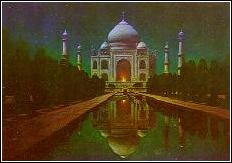
Taj Mahal!!! 
The Taj Mahal at Agra, one of the 7 wonders of the world is undoubtedly the finest achievement & the most exquisite of all Moghul buildings. In its flawless beauty it ranks among the most perfect monuments in the world. It was erected by Shah Jahan to the memory of his beloved queen, Arjumand Banu Begum, called Mumtaz Mahal ( exalted of the palace ). A year after her death in 1631 he began the Taj & it took twenty-two years to complete.
The Taj Mahal stands in a walled enclosure measuring around 580x305m. The red sandstone gateway at the south leads to a spacious ornamental garden(305sq m). Near the river Jamuna on the northern side of the enclosure, a low red stone terrace extends from one end of the wall to the other, terminating on both sides in a red standstone building. That on the west is a mosque, & the eastern one-its jawab (answer) - serves as mihman-khana (guest house) or as majlis khana (assembly hall).
In the centre, on a white marble platform almost seven metres high, is the rauza in glittering white marble, with four minarests at the corners of the plinth. The bevelled angles give this cubicle structure the shape of an irregular octagon. The elevation, equal on all four sides, is typically Islamic in design.
The greatest elegance of the Taj lies in its beautiful white marble dome surrounded by four chatris (smaller domed pavilions). The dome rests on a low drum. Lotus petals encircle its restricted base. It curves up gently to the pointed top, covered with radiating petals. While the dome reveals Persian influence, the four chatris are purely Indian.
Delicacy & grace characterise the beauty of the Taj. The white marble from the Makrana quarries has a texture of the finest quality. It shows subtle variations in colour with every change of light; dazzling white in the noonday sunshine, tinted pale rose at sunset, & gleaming like a pearl in the moonlight.
INDIA...a land for all seasons
The subcontinent of India lies in south Asia, between Pakistan, China and Nepal. To the north it is bordered by the world's highest mountain chain, where foothill valleys cover the northernmost of the country's 26 states. Further south, plateaus, tropical rain forests and sandy deserts are bordered by palm fringed beaches .
Side by side with the country's staggering topographical variations is its cultural diversity, the result of the coexistence of a number of religions as well as local tradition. Thus, the towering temples of south India, easily identifiable by their ornately sculptured surface, are associated with a great many crafts and performing arts of the region.
In the desert of Kutch, Gujarat, on the other hand, a scattering of villages pit themselves against the awesome forces of nature, resulting in Spartan lifestyles made vibrant by a profusion of jewelry and ornamental embroidery used to adorn apparel and household linen. In the extreme north is the high altitude desert of Ladakh. Local culture is visibly shaped by the faith - Buddhism -as well as by the harsh terrain. Yet another facet of Indian culture is observed in the colorful tribal lifestyles of the north eastern states of Nagaland, Mizoram, Tripura and Manipur with their folk culture.
In the central Indian states of Orissa and Madhya Pradesh tribal village life has resulted in a variety of artistically executed handicrafts.
India's mountains provide heli skiing, river running, mountaineering and trekking. Its beaches provide lazy sun-bathing as well as wind surfing and snorkeling, and its jungles provide shooting wildlife -with a camera.
India's history goes back to 3,200 BC when Hinduism was first founded. Buddhism, Jainism, Sikhism. Judaism. Zoroashtrianism, Christianity and Islam all exist within the country today. As a consequence of India's size, the history of the country has seldom been the same for two adjoining territories, and its great natural wealth has lured a succession of traders and foreign influences to it, each having left their imprint in the country, however faint or localized. Thus, Chinese fishing nets in Kerala are a throwback to that country's ancient maritime trade, while in the north, terra-cotta figurines of the centuries BC bear distinctly Greek traces.
Modern India is home alike to the tribal with his anachronistic lifestyle and to the sophisticated urban jetsetter. It is a land where temple elephants exist amicably with the microchip. Its ancient monuments are the backdrop for the world's largest democracy where atomic energy is generated and industrial development has brought the country within the world's top ten nations. Today, fishermen along the country's coastline fashion simple fishing boats in a centuries old tradition while, a few miles away. motor vehicles glide off conveyor belts in state-of-the-art factories


